
UPDATES COMING SOON

ALCHEMIST
Questioning living in the dynamic dune environment
Alchemist is an infrastructural community that occupies the arid landscape of the desert in Northern and Central Africa. Given that roughly 30% of the planet is desert, the goal of this project is to repurpose this otherwise inhospitable, obsolete terrain, while also providing energy as a resource to neighbouring and distressed countries.

UNIT DESIGN
Design of a closed loop automated minimal infrastructure
RESPONSIVE
BEHAVIOR
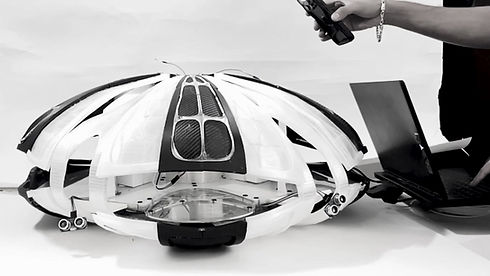
Transformation of the unit, to align the solar panels with the direction of light source, to maximise energy harvesting. This robotic prototype demostrates how the skin will actuate based on the direction of the sun.

INTERACTION
WITH USER
The living unit is divided into two livable spaces with a central circulation space that allows for connection corridors for other units to form a community. The Skeleton of the unit forms a structural framework for the skin and the actuation mechanism.

UNIT
STUCTURE

Pressurized Air
Frames
The solar panel frames are designed to enable for cleaning the top surface in case of accumulation of sand on the solar panels. It uses pressurized air that flows through the pipe system integrated in the structural frame of the unit top surface.
CASTING CARBON FIBRE
The unit is primarily composed of carbon fibre shell, which becomes the rigid component, supporting the solar panel and its frames. The carbon fibre was casted using resin infusion casting technique, with helps of CNC and vacuum formed moulds.


TOPOLOGY
OPTIMIZATION
The transformable arm is designed to be a structural component composed of carbon fibre monocoque and 3D Printed titanium compliant joint. The arm is topologically optimized to for light-weighting and create a blend between titanium and carbon fibre and is tested with multiple load conditions.

STUDIO ANGIUS X MELTIO
Compliant Node
Research and development of a compliant mechanism that allows for the desired transformation of the arm was iterated and optimized to be printed in titanium. The compliant node works as a series of rigid vs elastic connection, that allows to neglect wear and tear of the joint.

Displacement
Analysis
Buckling analysis in nTop involved simulating the behavior of Mild steel material elasticity under different forces and restraints points. These simulations help to understand the differential behaviors of the system, providing insights into the material’s response to force and restraint across multiple iterations, which inform the potential deformation outcomes.
Titanium 3D Print
The compliant node was printed in Titanium, in collaboration with Meltio. Multiple iterations of perforation patterns and interlocking mechanisms were rigorously analyzed to assess their mechanical compliance and material efficiency. The configurations exhibiting the highest performance in terms of compliance and resource optimization were subsequently selected for further refinement and implementation.


SCALE 1:1
Robotic Automation
& Printing
To evaluate the compliance of the node at a 1:1 scale, a prototype was fabricated using clear PLA through robotic arm-based 3D printing. This approach enabled precise control over the deposition process, ensuring accuracy and consistency in the geometry of the compliance node.
This test served as a critical step in verifying the performance and functionality of the design.


